The container office vs office trailer choice usually comes down to how your site works: how long the job runs, how often the office moves, how many people use it, and how much you worry about break-ins after hours. Both give a crew a dry place for plans, a desk and a phone charger. They get there in different ways. This is a neutral, feature-by-feature comparison, including the cases where a trailer is the better fit.
Container office vs office trailer: ground level vs on a chassis
An office trailer is built on a chassis with axles and a hitch. The office sits up on that frame, so the floor is well above the ground and you climb steps to get in.
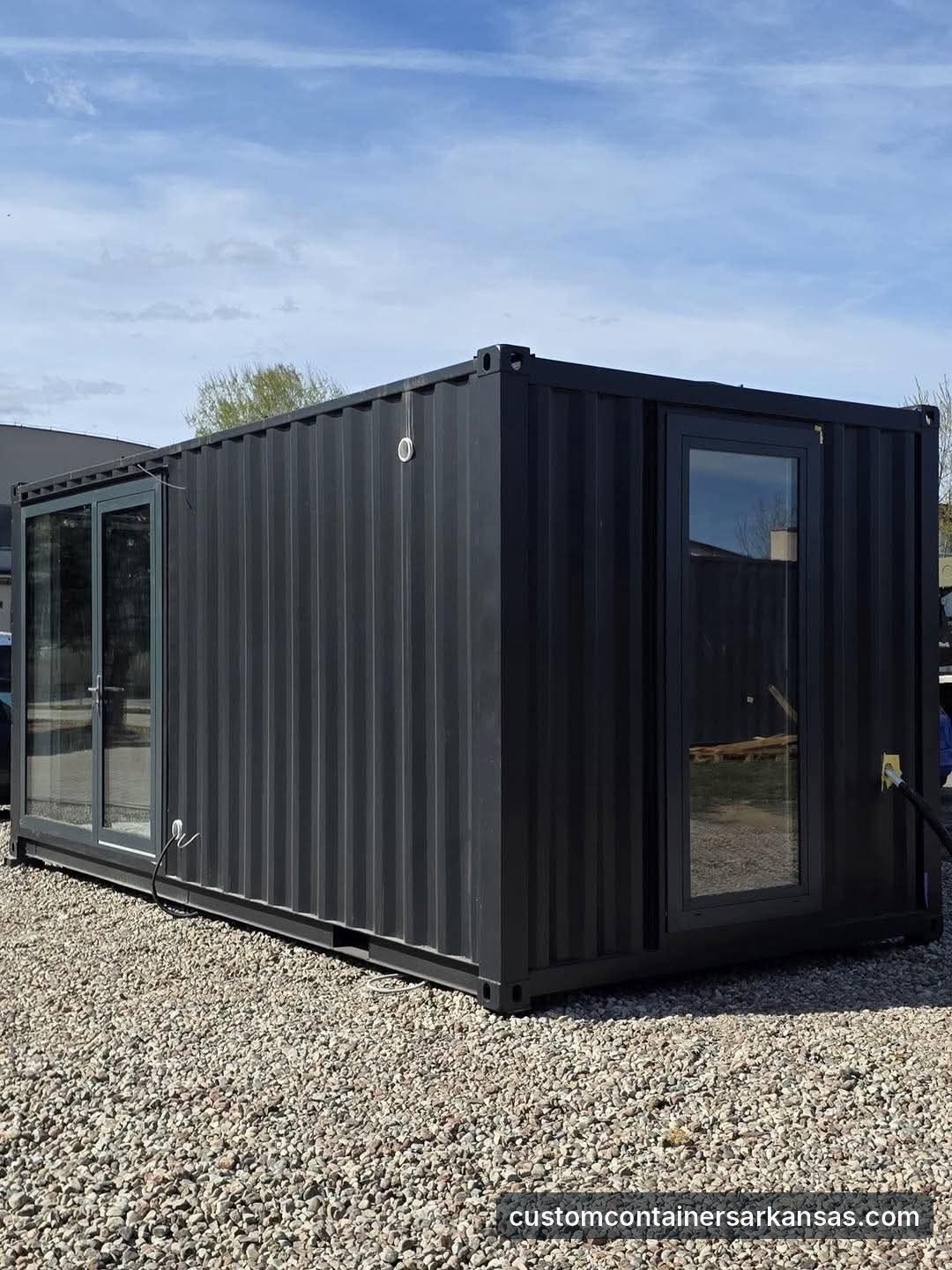
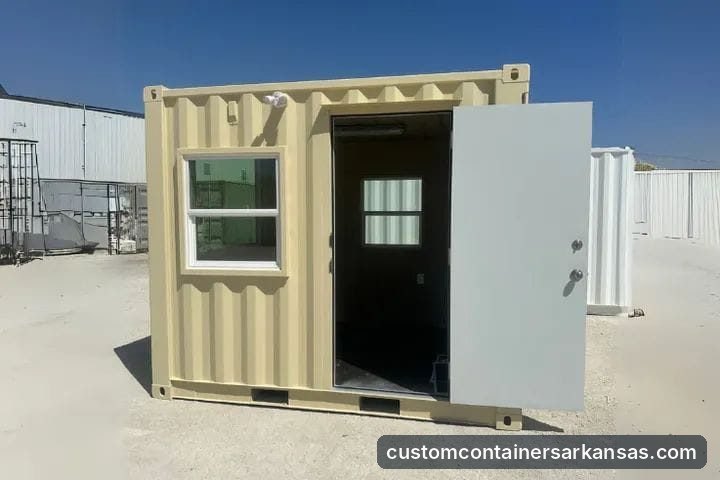
A container office is a steel shipping container fitted out as an office: a man door, windows, lighting, outlets and lined walls. It has no wheels. It sits directly on the ground, on blocks or a gravel pad, so the floor is a single low step up. That's what "ground level office" means.
Most of the other differences follow from that one.
Setup and site prep (no stairs or skirting)
Container office. The truck sets it down on a firm, level spot, and that's most of the setup. There's no hitch to unhook, no axles to block and, in most cases, no stairs to build. What it does need:
- A firm, level base: compacted gravel, concrete blocks under the corners or a slab.
- A clear path for the delivery truck, with room to tilt and slide the box off.
- A plan for power, if you want it on day one.
Our site-prep checklist walks through the base and the truck path.
Office trailer. A trailer is towed in, then leveled on jacks or blocking. Depending on the site and local rules, it may also need steps or a ramp, skirting around the base and tie-downs. None of that is hard, but it's more pieces to set up and take down at each job.
Tie-down and anchoring rules vary by city and county, for both types. Confirm with your city or county before setup.
Security and weather
This is where a container office stands out.
- Walls. Corrugated steel walls and roof. There's no thin siding to cut through.
- Doors. A steel man door with a lockset. Some layouts also keep the original cargo doors, which can be locked from inside.
- Windows. Windows can be fitted with security bars, or steel shutters that close over the glass at night, which are available on our 40ft office.
- Underneath. The floor sits on the ground, so there's no open crawl space under the unit.
Our guide to shipping container locks and security covers lockboxes and puck locks if you also keep tools on site.
For weather, a steel box shrugs off hail and blowing rain well. It still needs a roof that sheds water and a plan for condensation in winter, especially once people are breathing and running a heater inside. Neither type is a place to ride out a tornado. Follow your site's severe-weather plan.
Office trailers are built for people from the start, and many come with insulation, heating and cooling installed. A container office gets the same comfort features through its fit-out, so ask what's included in the build.
Layout and size limits: when a trailer is the better choice
This is the honest part. A container office is limited by the box. It's 8ft wide, whatever the length, and the height is set by whether it's a standard or high cube container.
An office trailer can be the better fit when:
- You need a wide room. Trailers are commonly made in wider sizes, and some join side by side into larger multi-room offices.
- Lots of people use it. A big crew, daily meetings or a plan room with a large table can outgrow an 8ft-wide space.
- You move every few weeks. If the office follows a road crew from site to site, wheels help (see below).
- You want a ready-made restroom. Some trailer models come with one fitted.
A container office makes more sense when security matters, when the site is muddy or uneven and you'd rather skip the stairs, when the job runs for months in one place, or when you want an office that can later become storage or a workshop.
Restrooms and utilities
Power. Lighting, outlets and a wall heater or air conditioner can be built into a container office before it ships. Hooking it up on site may need a licensed electrician, and you'll need a power source: a temporary service pole, a building nearby or a generator.
Water and restrooms. Plumbing in a container is a custom job, and it depends on having water and sewer, or a holding tank, at the site. On many job sites, a portable restroom handles this for either type of office. If you need a restroom inside, tell us early so we can tell you what's practical for your site.
Internet and phones. Steel walls can weaken cell signal inside. Plan for a hotspot near a window or an outside antenna if signal is weak on your site.
Moving it between jobs
Office trailer. If it's small enough and you have the right truck, you hitch it and go. Larger units need a hauler. Either way, it's quicker to move when the next job is down the road.
Container office. It moves by truck, usually a tilt-bed or roll-off, or by crane or forklift on the container's corner fittings. It's a bigger job than hooking up a trailer, so a container office suits jobs that last months, a yard office that stays put, or a site where you'll move it a few times a year.
Before each move, empty loose items, latch the windows and secure anything wired to an outside source.
Choosing a size: 10ft, 20ft or 40ft office
All three sizes share the same width, so the question is length and how many people need to work inside.
| Size | Typical fit | Good for |
|---|---|---|
| 10ft | One or two desks, a plan rack | A gate office, a foreman's office, small sites with little space |
| 20ft | Two or three desks, or a desk plus a small meeting table | A general contractor's site office or a farm office |
| 40ft | Room for an office plus a meeting area, or two rooms with a partition | Long projects, larger crews, a yard office or an office plus storage in one box |
See our 10ft office container for tight sites, the 20ft office container with a finished interior and a choice of steel or glass sliding door, or our 40ft office container, a finished build that can be open plan or split into up to four rooms, or compare all our shipping container offices for sale side by side. If you're running a job in or around Little Rock, our page on job-site offices in Central Arkansas covers delivery there.
Get a container office quoted
Tell us the size you're leaning toward, how many people will use it, the add-ons you want (windows, bars or shutters, power, heating or cooling) and your delivery ZIP. We'll be in touch within 1 business day with a written quote that includes delivery and sales tax. Payment is by bank transfer, and our bank details come with the quote.
Request your written quote. Delivery and sales tax are included.
Frequently asked questions
Can a container office sit next to a storage container?
Yes. Many sites set an office and a storage box side by side or facing each other. Leave room to open both sets of doors and for the delivery truck to reach each spot.
Can I add a second door or a partition to a container office?
Usually. Extra doors, windows and interior walls are custom add-ons we can build in our Marion yard before the office ships. Tell us the layout you want when you ask for a quote.