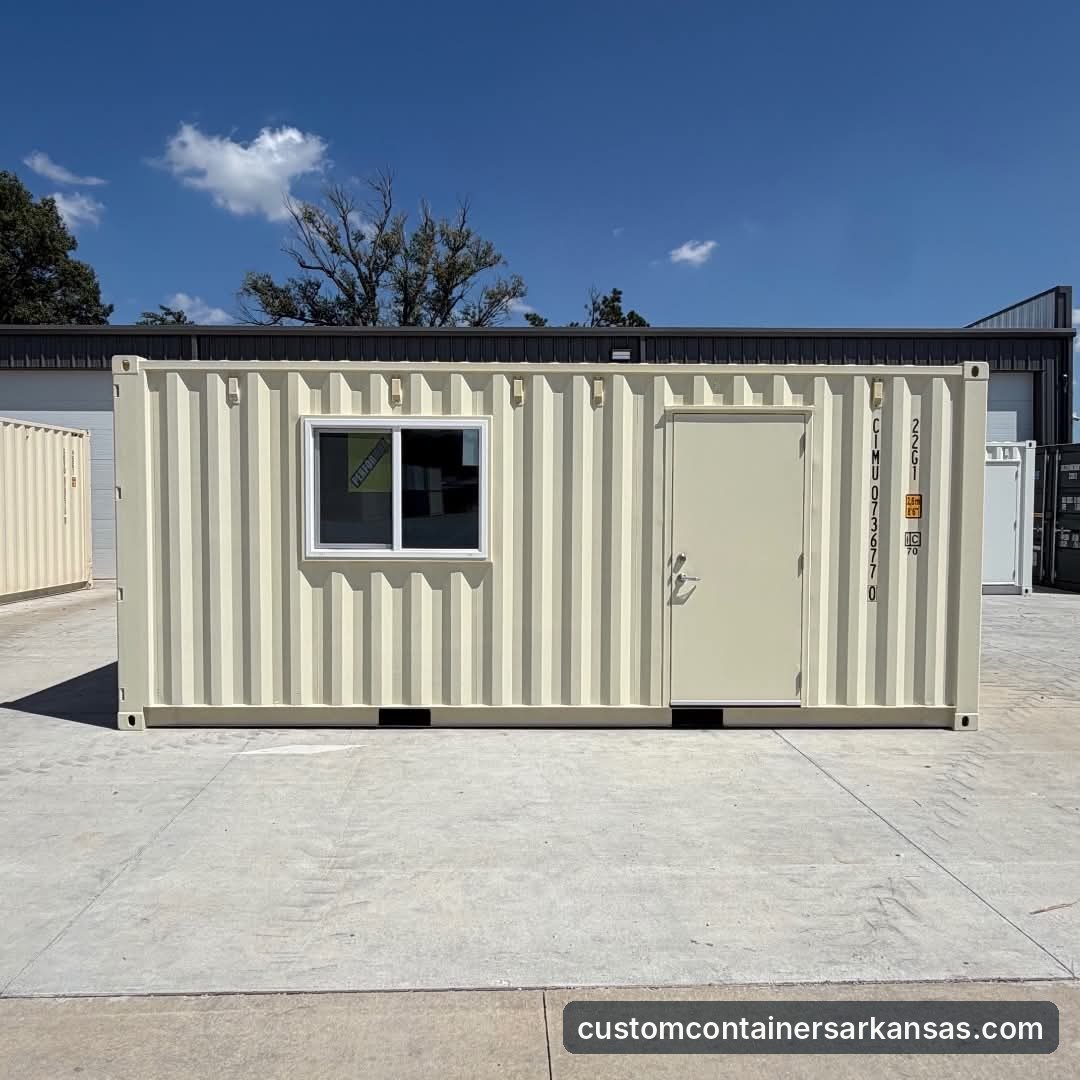
Start with how you'll use it every day
Deciding where to put a shipping container is easy to rush. Most people pick the spot the truck can reach and stop there. Delivery day matters, but you'll live with the spot for years. A container that floods at the doors, faces the wrong way or blocks the drive gets less useful every month.
So start with the daily routine, not the truck. Ask yourself:
- What goes in and out, and how? Hand-carried boxes, a wheelbarrow, a mower, pallets on a forklift?
- How often? Daily tool runs need a short, dry walk. Seasonal storage can sit farther out.
- Will anyone work inside? An office, workshop or cabin needs power, light and a clear path to the door.
- Will it stay put? If you might move it, sell it or swap it for a bigger one later, the spot needs a way back in for a truck.
Write the answers down. They decide most of what follows. If you haven't settled on a size yet, our container size calculator gives you a starting point, and the footprint changes which spots will work.
High, dry and level: drainage first
Water is the main enemy of any steel box sitting on the ground. Pick the high side of your lot, not the low corner where rain collects.
Walk the property during or just after a heavy rain if you can. Look for:
- Standing water or soft, spongy ground that stays wet for days
- Runoff paths from roofs, driveways and neighboring lots
- Ditches and swales that fill up in a storm
- Bare, washed-out soil that shows where water already runs
In the Delta and along river bottoms, clay ground can stay wet for a long time after rain. A spot that looks fine in a dry fall can hold water all winter.
Once you've found a high spot, plan to get the box up off the dirt. Most owners set the corners on concrete blocks, railroad ties or a compacted gravel pad, so air moves under the floor and the steel isn't sitting in mud. The ground needs to be firm and level so the doors line up and close properly. Our delivery-day site checklist covers base and ground prep.
Dry ground outside also helps keep the inside dry. Our guide on how to stop condensation in a shipping container explains why a container on wet ground sweats more in winter.
Which way the doors should face
The cargo doors are at one end, and you can't change that after the truck leaves. Before delivery, decide which way they'll point.
- Toward where you'll load. Face the doors toward your driveway, shop or house, so you aren't walking around the box with every load.
- Away from the prevailing weather where you can. Doors that catch wind-driven rain let more water in each time they open.
- Uphill, never downhill, on a sloped lot. Water running toward the doors pools at the seals and the floor edge.
- With swing room. Container doors swing out wide. Leave clear ground in front so both doors open flat, and a few extra feet to load.
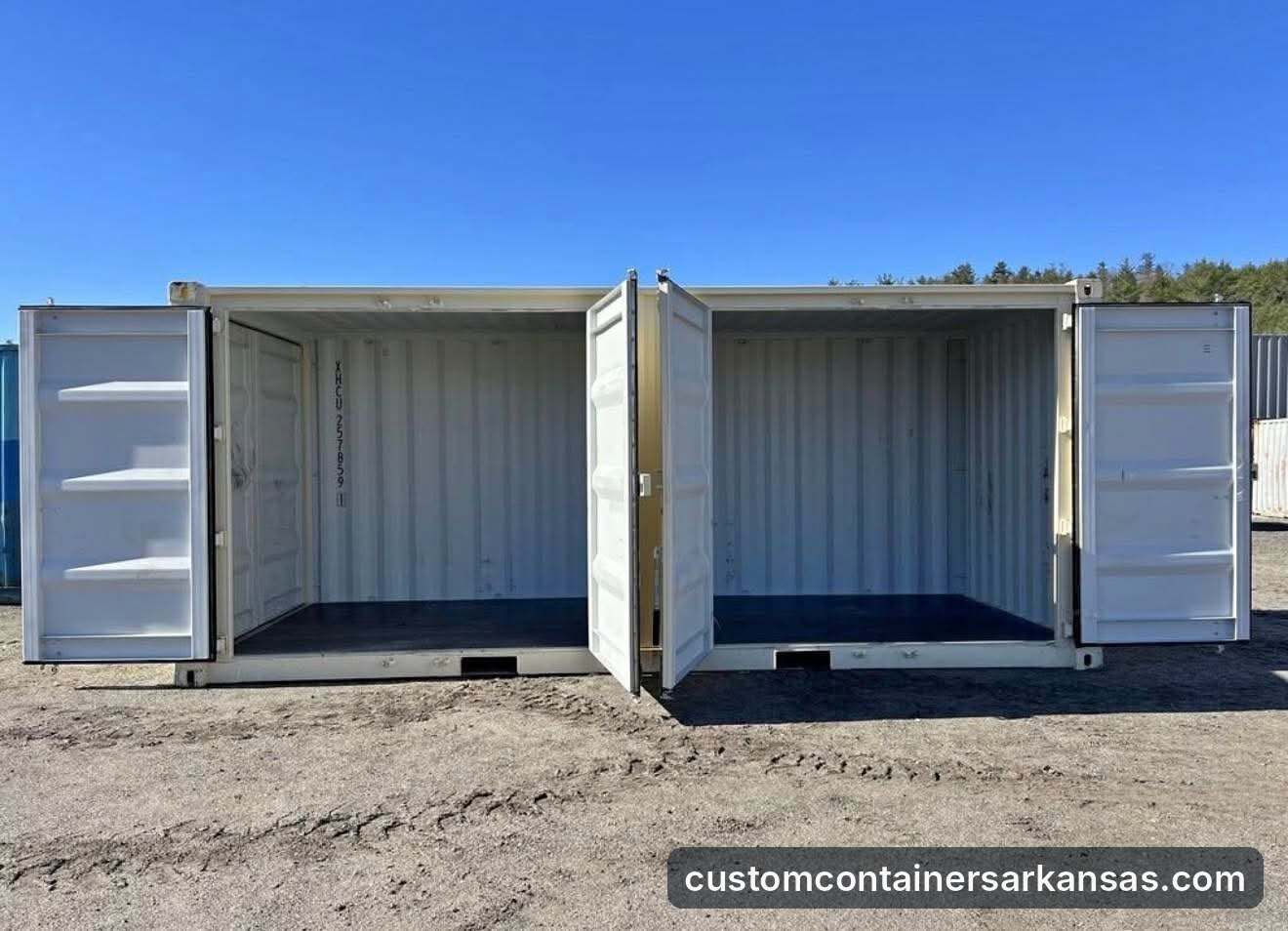
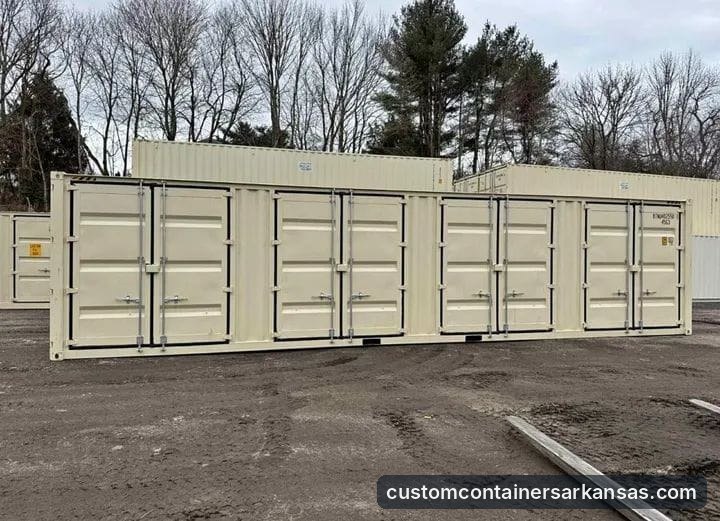
Open-side and roll-up units change the math. A container with doors along the long side needs that whole side clear. Our 20ft open-side container opens the full length of one side, so plan room there for the doors to swing open and for a forklift or truck to pull alongside.
If security matters, point the doors where people can see them, such as toward the house or road. Our post on shipping container locks and security covers how door direction and lighting work together.
Sun, shade and trees
A steel box heats up in summer sun and cools fast on a clear winter night. Neither is a reason to avoid open ground, but think it through:
- Full sun suits plain storage of tools and equipment, and it helps the roof dry after rain.
- Afternoon shade can make an office or workshop more comfortable in a humid Mid-South summer.
- Trees overhead are mostly trouble. Falling limbs can dent the roof. Sap, leaves and pine needles collect on top, hold water and speed up rust. Roots can also heave a base over time.
The safe middle ground is near trees but not under them, with a clear look at the sky above the roof. Look up before you choose the spot, and look for dead limbs.
Neighbors, sight lines and setbacks
Placement and permits overlap. Many cities, counties and HOAs have rules about how close a container can sit to a property line, where it can sit on the lot and whether it must be screened from the street. Read our guide to setback and permit rules in Arkansas, or the permits by state guide outside Arkansas, and confirm with your city or county before delivery.
If the container will become a cabin or a backyard unit, the rules are different again. Our Arkansas container ADU and tiny cabin guide covers that case.
Beyond the rules, a little courtesy goes a long way. A box tucked behind a fence line, painted a soft color or screened with plantings is easier for neighbors to live with than one parked against their yard.
Leave room for the truck to come back
The truck that delivers your container may have to come back for it one day. You might move, sell the box, trade up in size or relocate it to another part of the property.
Keep a clear lane to the spot:
- Don't build around it. Fences, sheds, decks and plantings can trap a container in place.
- Keep the approach open. The same straight-line room the truck needs on delivery day applies to pickup.
- Think about overhead wires and tree growth. A lane that's clear today may not be in five years.
- Don't bury utilities under the approach. A loaded truck can crack shallow lines.
Our 20ft vs 40ft guide shows how much more room a 40ft needs to get in and out. If your lot is tight, a 20ft may be the only size a truck can reach.
Where to put a shipping container: a 5-minute sketch
Before you order, sketch your lot. It doesn't need to be to scale. Mark these on it:
- Property lines, fences and buildings
- The driveway or gate the truck will use, and any tight turns
- High and low ground, and where water runs in a storm
- Trees, overhead wires and anything buried, such as septic, water or gas lines
- The container's outline, with an arrow showing which way the doors face
- Door swing room, plus the long side if it's an open-side or roll-up unit
- Your daily path from the house, shop or road to the doors
- The truck's path in, and back out again later
Take a phone photo of the spot from the road and one from where the doors will face. Send both with your sketch when you ask for a quote. It helps us understand the site, and you'll catch most problems before the truck shows up.
When a container isn't a good fit: if every spot on your lot is low, wet, steep or out of reach of a truck, fix the ground first or rethink the plan. A container can't solve a site that has no workable spot.
Get a container quoted for your spot
Send us your delivery ZIP, your sketch and photos, and what you plan to store or do inside. Tell us which way you want the doors to face and whether you need extras like vents, a man door or shelving. We'll be in touch within 1 business day with a written quote that includes delivery and sales tax. Payment is by bank transfer, and our bank details come with the quote.
Request a quote for your container. Delivery and sales tax are included.
Frequently asked questions
Can a shipping container sit on a slope?
A gentle slope can work if the corners are leveled with blocks or the ground is graded flat. A level box keeps the doors opening and closing properly. On a steep slope, talk to a local site contractor first.
How close to a fence or building can a container go?
Setbacks are set by your city, county or HOA, so check with them first. Beyond the rules, leave enough room to walk around the box, open every door and reach the roof edge for checks.