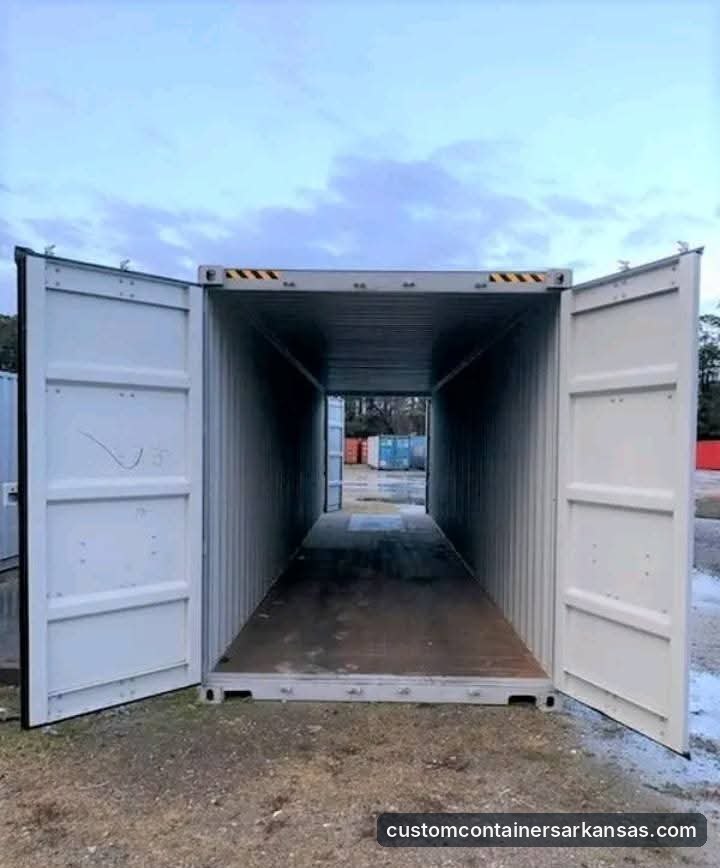
A tunnel container is a shipping container with full cargo doors at both ends instead of one. Open both and you can see straight through it, load from either end, or drive a forklift through. You'll also see it called a double door container or a double-ended container. They all mean the same thing. Ours is the 40ft high cube double door (tunnel) container. This guide explains how it differs from a standard or open-side container, what it's good at, and what to plan before it's delivered.
What is a tunnel container?
A standard shipping container has one set of cargo doors at one end and a solid steel wall at the other. To reach anything at the back, you walk in from the front.
A double door container replaces that solid end wall with a second set of cargo doors. Both ends open fully, so the container works like a covered tunnel: in one end, out the other.
One point trips people up. Every standard container already has a pair of doors at its door end, so "double doors" sounds like something they all have. In the container trade, a "double door container" means door sets at both ends, not a pair of doors at one end. If a listing or quote is unclear, ask whether the doors are at one end or both.
Our 40ft high cube tunnel container
Here's the listed spec for our 40ft High Cube Double Door (Tunnel) Container:
| Feature | What you get |
|---|---|
| Outside size | 40' L × 8' W × 9'6" H |
| Inside (approx.) | 39'5" × 7'8" × 8'10" |
| Doors | Full cargo doors at both ends |
| Floor | About 300 sq ft |
| Condition | Shown in your written quote |
It's a high cube, so it has about a foot more headroom than a standard 40ft. That helps with tall pallets, racking and equipment.
Why choose doors at both ends
Doors at both ends earn their keep in a few specific situations:
- Long items. Pipe, lumber, ladders and trailers can go in one end and come out the other, with no turning them around inside.
- Drive-through loading. A forklift can enter one end and leave by the other, so there's no backing out of a 40ft box.
- Stock rotation. Load new stock at one end and take the oldest out the other. Anything with a shelf life or a season moves in order.
- Awkward sites. If the container can't be turned around on your lot, or only one end will face the drive, doors at both ends mean you're never stuck with the doors facing the wrong way.
- Two working ends. Each end opens on its own, so stock you use every day can sit near one end and seasonal gear near the other.
- Airflow on a hot day. With both ends open, air moves through the full length while you work inside.
Tunnel container vs open-side vs standard
| Standard container | Tunnel container | Open-side container | |
|---|---|---|---|
| Doors | One end | Both ends | Long side, plus standard end doors |
| Reach the middle | Walk in from the end | Walk in from either end | Straight from the side |
| Long items | In and out the same end | Straight through | From the side |
| Room needed | Door swing at one end | Door swing at both ends | Door swing along the side |
| Openings to lock | One set | Two sets | Several sets |
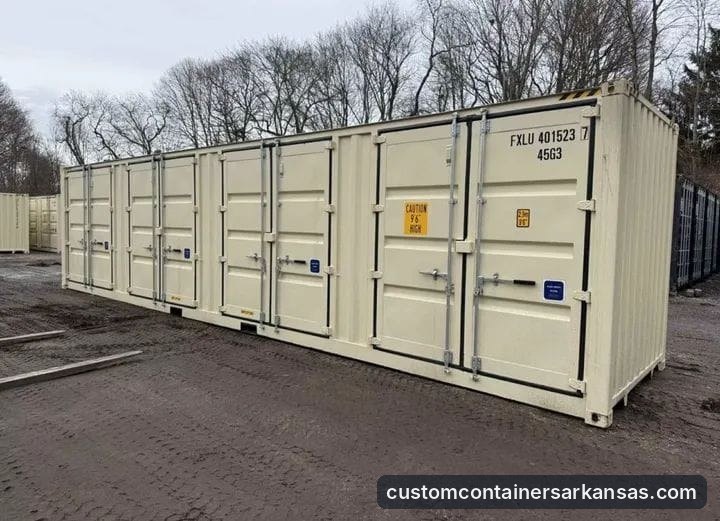
If you need to reach things in the middle, or load wide items from the side, look at our 40ft high cube open-side container instead. Our open-side container vs roll-up door guide compares side-access options. You can also line up every unit side by side on our compare containers page.
When doors at both ends aren't the right fit
- You mostly need the middle. In a 40ft, the middle is about 20ft from either door. Side access suits that better.
- There's no room at one end. If one end sits against a fence, a building or a slope, those doors won't open, and you've paid for doors you can't use.
- You rarely open it. For long-term storage you visit a few times a year, a standard container is simpler.
- You want the fewest openings. Two door sets means two places to lock and two sets of seals to check.
Planning placement and delivery
Doors at both ends only help if both can open, so plan the spot around that:
- Leave swing room at both ends. Each cargo door is about 4ft wide, so keep at least that much clear space at each end. Add room for a forklift or truck if you'll load from that end.
- Set it level on a firm base, such as compacted gravel, solid blocks under the corners or a slab. A container that's out of level can keep doors from closing and sealing, and with doors at both ends you'll notice it twice.
- Think about the drive-through path. If you plan to drive a forklift through, make sure the ground at both ends is firm and level with the container floor approach.
- Lock both ends. Use a good padlock at each end, and consider a lockbox shroud on each. Our shipping container locks and security post covers lock types.
- Tell us how it should sit. Let us know which end should face your drive or work area when you order, and send a photo of the spot.
Get your double door container quoted
Tell us what you'll store, how you'll load it, and your delivery ZIP. A photo of the spot helps us plan the delivery. We'll be in touch within 1 business day with a written quote that states the container's condition and includes delivery and sales tax. Payment is by bank transfer, and our bank details come with the quote. Text or call (870) 384-8454, or email info@customcontainersarkansas.com. Our yard isn't open to visitors, so every container is delivered to you.
Request your written quote. Delivery and sales tax are included.
Frequently asked questions
Is a tunnel container the same as a double door container?
Yes. Tunnel container, double door container and double-ended container all describe a shipping container with full cargo doors at both ends instead of one.
Can I add a second set of doors to a container I already own?
Ask us. Custom modifications are built in our Marion yard before a container ships, so tell us what you need and the work will be listed in your written quote.